


Why This Shift Is Urgent and Commercially Critical
In the age of zero-click search, AI tools like Google’s AI Overviews, Bing’s Copilot, and conversational engines deliver direct answers to users, often sidestepping traditional search rankings. Brands that have relied on keyword strategy and rankings are now seeing a dramatic fall in organic clicks, even if their page “ranks” in the old sense. If your content isn’t cited or referenced by the search engine’s AI, your traffic, and business pipeline, can disappear almost overnight. This isn’t a future problem; the data shows it’s happening now for many industries, and by 2026, it will be the rule, not the exception.
What’s at Stake for Brands?
- Diminished organic traffic and weaker lead pools.
- Less control over brand messaging, as AI summarizes and cites who it considers authoritative.
- An urgent need to shift from tactical, short-term SEO fixes to a strategic, long-term authority-building approach.
The End of Organic Ranking (As We Knew It): E-E-A-T with SEO Strategy is the New Algorithm
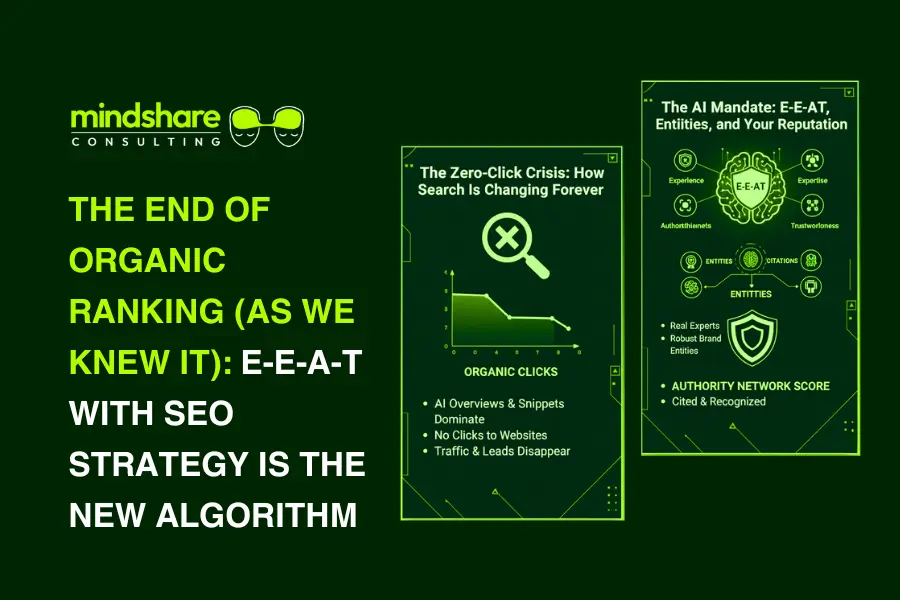
The Zero-Click Crisis: How Search Is Changing Forever
By 2026, nearly every search that can be answered by AI will be answered directly, without a user clicking through to read your full content. This “zero-click” environment means:
- Featured snippets, knowledge panels, and AI aggregations control most answers.
- Only the most authoritative sources (clearly cited and recognized in entity databases) are included in these answers.
- Brands without verifiable authority are omitted from AI recommendations and lose visibility.
The AI Mandate: E-E-A-T, Entities, and Your Reputation
Google’s shift to E-E-A-T (Experience, Expertise, Authoritativeness, Trustworthiness) is not just incremental, it’s a seismic change. Search engines now reward content from real experts, robust brand entities, and organizations with a track record of original research and authority citations. This new model also requires brands to signal their expertise and trustworthiness everywhere their entity appears online, not just on their website. See Google’s full perspective here: Creating helpful, reliable, people-first content.
Introducing The Authority Network Score (ANS): Quantifying Your SEO Future
The Authority Network Score (ANS) is a new, holistic approach for measuring digital authority and predictive search performance. Unlike traditional metrics (like link count or domain authority), ANS tracks external citations, mentions, data references, and the breadth of your digital expertise, across high-authority publishers, databases, media appearances, and social graphs.
- A high ANS signals to AI that your brand is the authoritative “root node” for your space.
- ANS correlates strongly with inclusion in AI answers and is now a more reliable predictor of visibility than any on-page keyword metric.
Learn about entity-based structured data: Schema.org.
The 3 Pillars to Secure Your Future of Organic Ranking
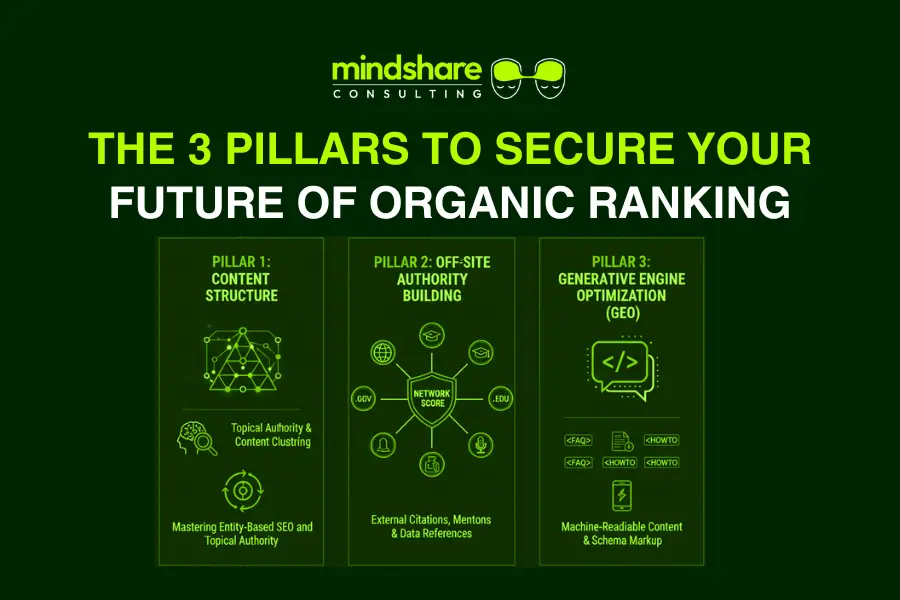
Pillar 1: Content Structure, Mastering Entity-Based SEO and Topical Authority
Entity-Based SEO: The future of SEO is about proving your brand “owns” the main concept, expertise, or answer for a specific search intent. Rather than compete with thousands on individual keywords, successful brands are recognized by AI as the source for clusters of related topics, a composite view only achieved through entity-based and semantic SEO, not just keyword repetition.
Topical Authority and Content Clustering:
- Comprehensive content clusters go far beyond single articles. By creating interconnected pillar pages and topic clusters, you create a hub of information that answers every relevant question for a specific audience, improving both human understanding and AI extractability.
- Each page should reference and support others, forming a semantic network (or “entity graph”) detectable by AI and search algorithms.
Learn to build these content ecosystems with Mindshare’s guide proposing to utilize 12 low hanging seo tactics to boost ranking.
Practical Steps:
- Conduct an entity audit: Identify what core topics and authoritative personas your brand must “own.”
- Build or restructure content into comprehensive clusters around these entities.
- Every major theme should have: A pillar page, numerous supporting pages, internal linking, rich FAQs, and clear schema organization.
Pillar 2: Off-Site Authority Building (The Network Score)
A New Age of Backlinks: Not all backlinks are equal as we move in 2026. What matters is the nature and context of every mention, citation, and endorsement outside your owned properties:
- AI and search engines measure external signals from .gov, .edu, media, peer-reviewed journals, and major trade publishers far more heavily than from generic sites.
- Quotes, co-authored bylines, and distinctive original research are the most prized forms of off-site authority.
- Your Authority Network Score grows as your research, insights, and experts are cited (with your brand as an entity anchor) on credible, third-party platforms.
Find out why expert signal is so crucial: Moz – Why Author Authority Matters.
Off-Site Authority Best Practices:
- Publish unique research, data, and expert analysis likely to be referenced.
- Pursue content collaboration, guest slots, co-branded webinars, and industry panels.
- Systematically monitor for citations, mentions, and awards, each is a new “edge” in your Authority Network you can nurture and expand.
Modern AI engines scan for:
- Brand and author mentions across Google Scholar, Wikipedia, news articles, and metadata-rich databases.
- Consistency of expertise and identity (e.g., the same expert cited across multiple high-profile domains).
- Signals of integrity (trust badges, security certifications, compliance records).
Pillar 3: Generative Engine Optimization (GEO)
What is GEO and Why Does It Matter? Generative Engine Optimization focuses on making your site the definitive source for AI-powered search tools, not just humans.
- It means structuring your answers so they are “machine readable” for LLMs: Clear, parseable, and context-rich.
- A core element is embedding FAQ and HowTo Schema (and similar markup) so AI knows exactly where to extract and cite your authoritative content.
GEO Action Plan:
- Rewrite key content sections (like Q&As, definitions, and process guides) for clarity and conciseness so AI can “pull” them as authoritative.
- Layer in schema for each context (FAQ, HowTo, Article, Medical, Product).
- Anticipate user queries by answering them directly and fully, mirroring how AI would synthesize answers for high-intent questions.
Practical Example: A “How To” guide on your website should:
- Use precise headings and steps.
- Archive original data with references for AI to trace.
- Tag properly with HowTo and FAQ schema so the guide is surfaced not just by Google, but also by new AI assistants, voice devices, and aggregator apps.
The Role of Digital Identity and Trust in GEO
LLMs weigh author and organizational signals to avoid “citation spam.” Building author pages, and digital credentials is now critical. Brands must ensure that everything published is traceable to real, credentialed experts with visible reputations.
Secure Your Future of SEO Visibility
3 Steps to Calculate Your Authority Network Score
- Audit E-E-A-T: Review all existing sites and linked pages against the latest Google E-E-A-T guidelines, with attention to author bios, real credentials, up-to-date expertise signals, and the presence of third-party validation.
- Map Entities: Identify and document all core companies, products, and author entities. Assess their current footprint and citation profile on external authoritative sources (not just your own domain).
- Build Citable Assets: Develop original, thoroughly researched content assets, case studies, white papers, and primary research that external authorities will want to cite. Cut “disposable” fluff and invest in cornerstone resources that build reputation over time.
Additional Action Step: Monitoring and Evolving Your ANS
- Use entity and citation tracking tools to measure ongoing shifts in your Authority Network Score.
- Regularly audit off-site citations and approach gaps deliberately, target new partnerships, media, and expert networks.
- Stay ahead by updating schema, bio pages, and authoritative assets as algorithmic preferences and AI paradigms evolve.
Don’t Wait for the Future of SEO, Own It
The end of keyword-centric SEO is not an industry headline, it’s a boardroom reality. C-suite leaders who make the Authority Network Score a core business KPI will dominate AI-era organic discovery, while their competitors fade into digital obscurity.
Let Mindshare Consulting audit your current Authority Network Score and build a robust, future-proof E-E-A-T SEO strategy for your brand so you remain not just visible but essential in tomorrow’s search landscape.
The End of SEO Keyword Strategy is here. Schedule your call with Mindshare Consulting and learn how we can strategically help you.