
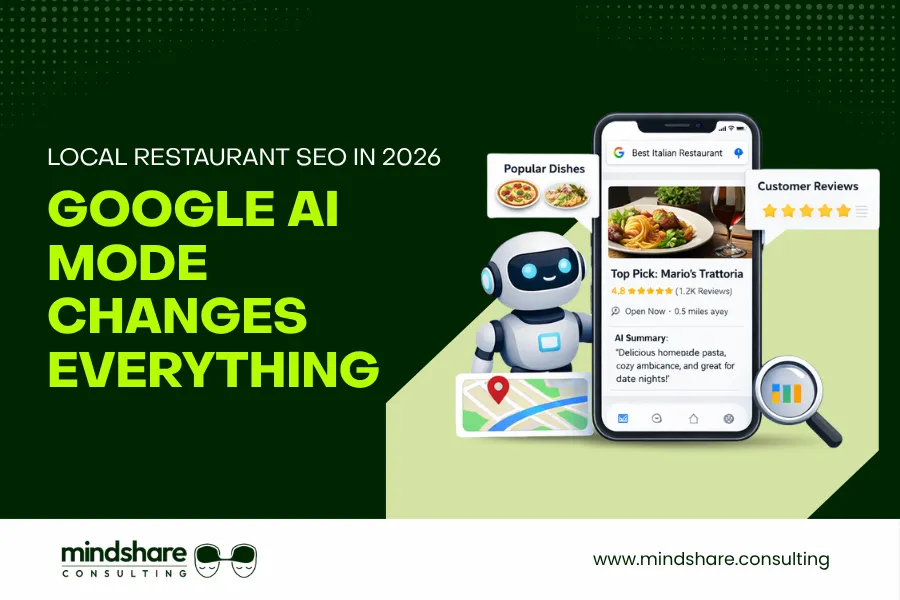

Everything you knew about local restaurant SEO just changed.
For years, the local SEO playbook for restaurants was predictable: claim your Google Business Profile, build some citations, get a handful of reviews, and make sure your address was consistent across the web. Do those things reasonably well and you would show up in the local map pack. Diners would find you.
That playbook is not dead but it is no longer enough. Not even close.
In 2026, local restaurant SEO Google AI Mode has introduced an entirely new layer of competition. Google’s Ask Maps feature powered by Gemini AI has changed how diners discover restaurants and restaurant marketing services. Instead of browsing a list of nearby options, they ask one conversational question and receive one single AI-recommended restaurant in response.
One restaurant wins. Every other restaurant in your area gets zero visibility for that search.
If your restaurant’s local SEO strategy has not been rebuilt for this new reality, you are already losing customers to competitors who have. This article explains exactly what changed, what to stop doing, and what your restaurant SEO must look like right now.
Also check: How to Use Google Business Profile for Restaurants to Get More Customers
What Changed: The Old Local SEO vs The New AI Era
To understand why local restaurant SEO Google AI Mode demands a different approach, you need to see clearly what the old playbook was built for and why that environment no longer exists.
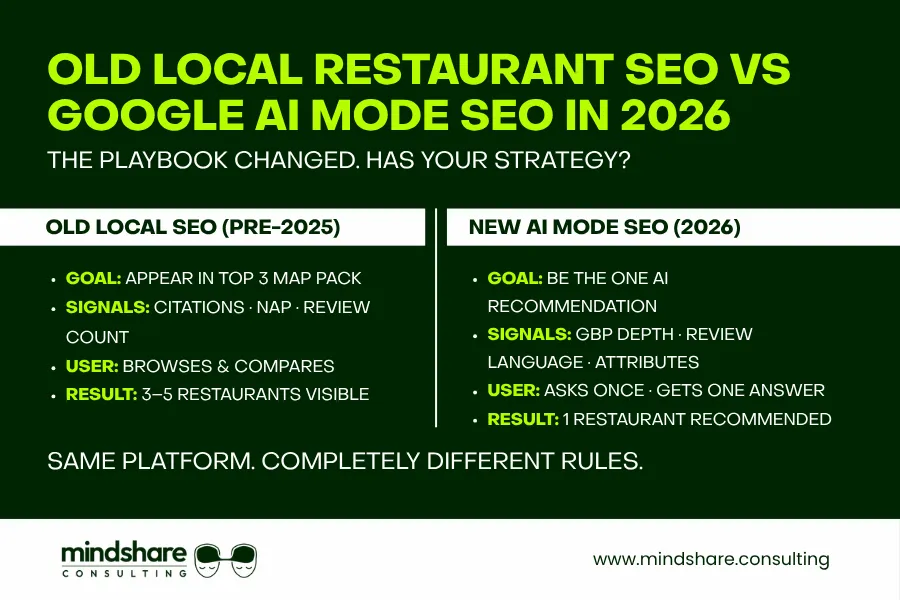
- The Old Local SEO Environment (Pre-2025): A diner opened Google Maps, typed “Italian restaurant near me,” and saw a map pack of three to five restaurants ranked by proximity, star rating, and review count. Your goal was simple: be in those three spots. The signals that got you there were citations, consistent NAP data, review volume, and a reasonably complete GBP profile.
- The New AI Mode Environment (2026): A diner opens Google Maps and types or speaks: “Find me a romantic Italian restaurant near downtown with good pasta and a quiet atmosphere for a date night.” The Gemini AI reads that query, scans GBP profiles, reviews sentiment, photos, attributes, and menu data then recommends one restaurant. One.
- The diner does not see a list. They see your restaurant or they do not see you at all.
This is the fundamental shift driving the new era of local restaurant SEO Google AI Mode. The signals that rank you in the old map pack and the signals that get you recommended by Ask Maps are related but they are not the same. Restaurants treating them as identical are leaving significant visibility on the table.
What to Stop Doing: Old SEO Habits That No Longer Work Alone
The shift to local restaurant SEO Google AI Mode means some practices that used to drive results are now insufficient on their own. Continuing to rely on them exclusively while ignoring AI-era signals is the fastest way to become invisible to high-intent diners.
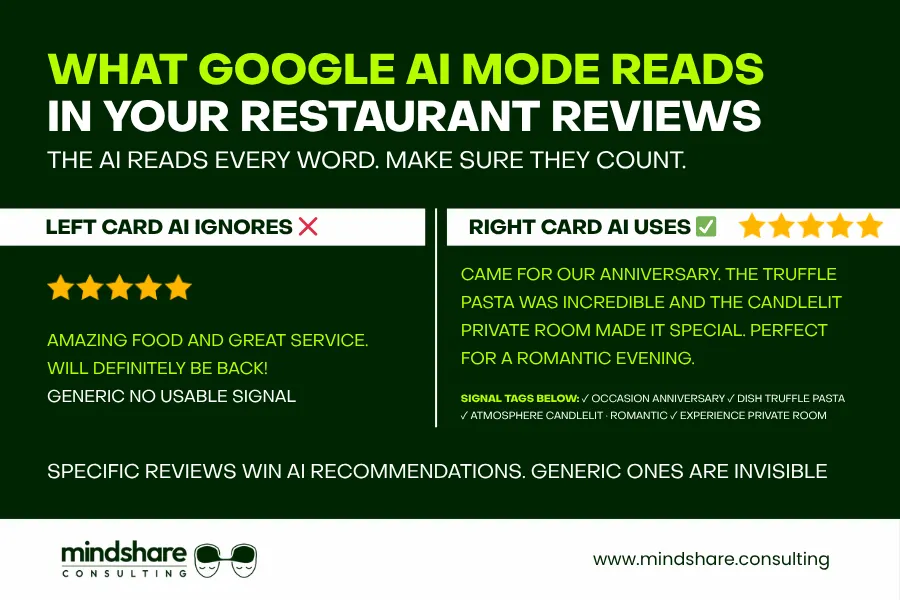
- Stop treating review count as your primary review goal: In the old map pack, more reviews generally meant higher visibility. In Ask Maps, review language matters more than review volume. A restaurant with 80 detailed, descriptive reviews consistently outranks one with 300 generic five-star reviews in AI recommendations. The Gemini AI reads what customers say, not just how many said something positive.
- Stop writing generic GBP descriptions: Descriptions like “authentic Italian cuisine in a warm, welcoming atmosphere” give the AI almost nothing to work with. Every restaurant in your city says something similar. The AI cannot confidently match a generic description to a specific user query. Specificity is what creates AI-readable relevance.
- Stop ignoring your GBP attributes: In the old local SEO playbook, attributes were a nice-to-have. In the AI Mode era, they are a primary matching signal. When a diner asks for a restaurant with outdoor seating, a private dining room, or a vegan menu the AI filters by attributes first. If yours are incomplete, you are filtered out before the AI even considers your reviews or photos.
- Stop treating your menu as an afterthought: Your Google Business Profile menu section is now a direct AI input. Dish names, dietary tags, and price ranges in your menu feed the AI’s ability to match your restaurant with specific food-related queries. A restaurant with a detailed, updated menu on GBP has a structural advantage over one with an empty or outdated menu section.
What to Start Doing: The New Local Restaurant SEO Playbook
Here is what local restaurant SEO Google AI Mode optimisation actually looks like in practice the specific changes that move the needle in 2026.
Rewrite Your GBP Description for Conversational Queries
Your GBP description needs to answer the questions diners actually ask, not describe your restaurant in marketing language.
- Old description:“Family-owned Italian restaurant serving authentic pasta and pizza in a cosy setting since 2012.”
- AI-optimised description:“Downtown Chicago’s go-to for date night Italian dining since 2012. Known for handmade pasta, wood-fired pizza, and an intimate candlelit atmosphere. Private dining available for groups of 8 to 20. Extensive Italian wine list. Vegetarian and gluten-free options on every menu. Open Tuesday to Sunday, 5pm to 11pm. Valet parking available.”
The second description contains occasion signals (date night, private dining), atmosphere signals (candlelit, intimate), dietary signals (vegetarian, gluten-free), practical signals (parking, hours), and specific dish signals (handmade pasta, wood-fired pizza). Every one of those details is a potential match for a specific diner query in Ask Maps.
Also check: How to use AI For Austin Restaurants Marketing to Get More Orders, Reviews, and Repeat Customers
Build a Review Strategy Around Occasion and Dish Language
Guide every diner toward leaving a review that contains the specific details the AI needs the occasion, the dishes they ordered, the atmosphere, and the service experience.
Instead of asking generically for a review after a meal, train your front-of-house team and post-visit messaging to be specific:
“Hi [Name], thank you for celebrating your anniversary with us last night. We would love it if you shared your experience on Google. It would really help if you could mention what you ordered and what the evening felt like.”
That one instruction consistently produces reviews containing occasion types, dish names, and atmosphere descriptions exactly the language the Gemini AI scans when matching your restaurant to queries like “best anniversary dinner restaurant near me.”
This is the single highest-leverage change any restaurant can make to its local restaurant SEO Google AI Mode strategy right now.
Complete Every Restaurant-Specific GBP Field
Beyond the description and reviews, these GBP fields are now active AI ranking signals for restaurants specifically:
- Dining Attributes: Mark every applicable option dine-in, takeaway, delivery, outdoor seating, private dining room, live music, reservations required, good for groups, good for kids, romantic atmosphere, sports bar. The AI filters restaurants by these attributes before evaluating anything else.
- Menu Section: Add every dish category with individual item names, descriptions, and prices. Dietary tags vegan, vegetarian, gluten-free, halal are critical matching signals for queries that include dietary requirements.
- Price Range: Set your price range accurately. Diners frequently include budget signals in their queries (“good Italian restaurant under $50 per person”) and the AI matches price range attributes directly.
- Photos: Upload a minimum of 25 to 30 high-quality images covering food close-ups, interior ambiance, outdoor seating, private dining spaces, and signature dishes. Name every file descriptively before uploading truffle-pasta-date-night-chicago.jpg and add captions. The AI reads both.
- Special Hours and Occasions: Keep your holiday hours, special event availability, and seasonal menu updates current. Outdated information is a trust penalty the AI will not confidently recommend a restaurant whose listed hours may be wrong.
Also check: How to Rank Your Restaurant on Google Maps Using a Smart Marketing Strategy
The Website Connection: Why Your Restaurant Site Still Matters
Your website plays a supporting but important role in local restaurant SEO Google AI Mode. When the AI considers recommending your restaurant, it cross-references your GBP claims against your website to verify consistency and depth.
Three website priorities for AI-era restaurant SEO:
- Keep your online menu current and crawlable. Your website menu should match your GBP menu exactly. Inconsistencies between the two create trust gaps the AI penalises. Make sure your menu is in HTML text not buried inside a PDF or image file the AI cannot read.
- Create occasion-specific landing pages. A dedicated page for “Private Dining in [City]” or “Valentine’s Day Dinner [Restaurant Name]” gives the AI location-specific, occasion-specific evidence that you genuinely serve those needs not just a GBP attribute that says you do.
- Add schema markup for restaurants. Restaurant schema covering cuisine type, price range, hours, menu URL, and reservation links structures your website data in a format the AI can read and use directly. This is a technical SEO step many restaurant websites still lack entirely.
Also check: The Future of SEO: Why Keyword Strategy is Dead and Authority Network Score will be King
Conclusion
Local restaurant SEO Google AI Mode is not a future trend to monitor. It is a present reality that is already determining which restaurants get discovered by high-intent diners and which ones get skipped entirely.
The restaurants winning in 2026 have made three specific shifts: they have rebuilt their GBP profiles to be specific and AI-readable, they have built review strategies focused on descriptive occasion and dish language, and they have aligned their websites to confirm and deepen every claim their GBP makes.
The restaurants still running the old years for local SEO playbook are becoming invisible not because Google stopped favouring them, but because they stopped speaking the language the AI now uses to make recommendations.
The good news: the gap between where most restaurants are and where they need to be is closable. But it requires the right strategy, not just more effort in the wrong direction.
Connect with Mindshare Consulting to build a local restaurant SEO strategy that is engineered for the AI Mode era and start showing up as the one recommended restaurant, not one of the invisible ones.