
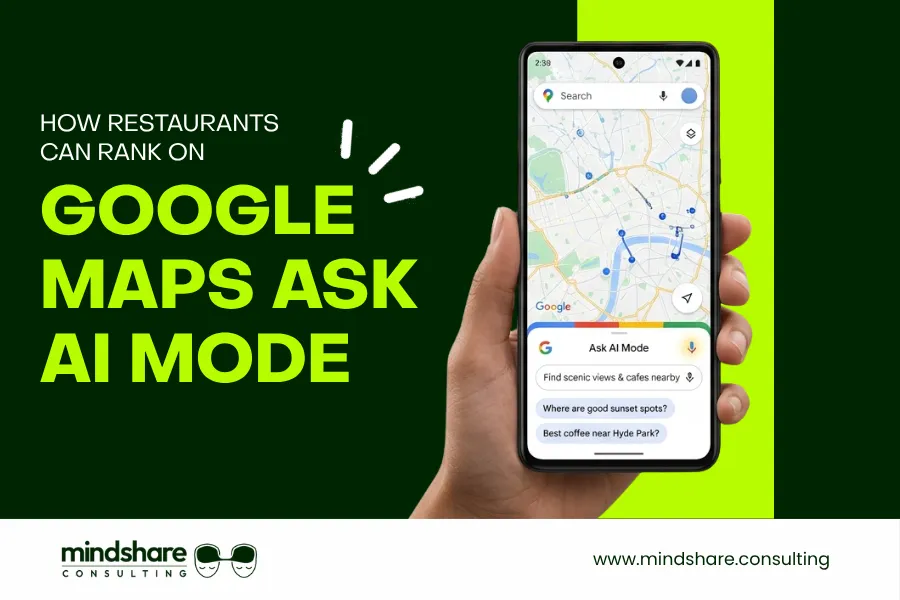

A diner picks up their phone tonight and types: “Find me a romantic Italian restaurant near downtown with great pasta and a quiet atmosphere for a date night.”
Google does not show them a list of options. It recommends one restaurant. One. The diner taps the call, makes a reservation, and spends $200 at dinner.
Your restaurant either receives that recommendation or it receives nothing.
This is the new reality of restaurant rank on Google Maps Ask AI Mode in 2026. Google’s Ask Maps feature, powered by Gemini AI, has replaced the browse-and-compare behaviour of traditional Maps search with a single confident AI recommendation. And the signals that determine which restaurant wins that recommendation are completely different from the signals that drove traditional local SEO.
From GBP optimisation and review strategy to occasion-specific content and photo planning explore the restaurant marketing services to get started. This guide covers exactly what your restaurant needs to do step by step to become the one restaurant the AI recommends.
Also check: How to Rank Your Restaurant on Google Maps Using a Smart Marketing Strategy
Why Ask Maps Is Different for Restaurants Specifically
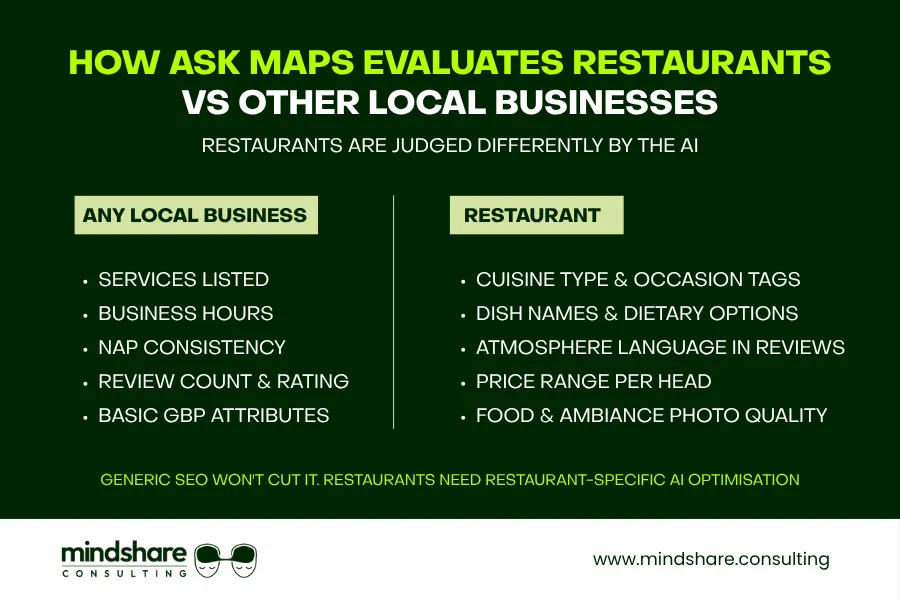
Most Google Maps AI content is written for generic local businesses plumbers, dentists, accountants. Restaurants are fundamentally different, and the way Ask Maps handles food-specific queries reflects that difference.
When a diner asks Ask Maps a restaurant question, the Gemini AI is simultaneously evaluating signals that simply do not exist for other business types: cuisine style, dining occasion, atmosphere, dish quality mentions in reviews, dietary accommodation, price range per head, ambiance descriptions, and reservation availability.
A query like “best place for a birthday dinner under $60 per person with a view” requires the AI to match against cuisine tags, price range attributes, occasion signals in reviews, photo quality showing the view, and GBP atmosphere descriptions all at once.
This means helping restaurants rank on Google Maps Ask AI Mode requires a restaurant-specific optimisation strategy not a generic local SEO checklist applied to a food business.
The five areas that matter most for restaurants specifically are: GBP description quality, dining attribute completeness, menu data, review language strategy, and photo library depth. This guide covers all five.
Step 1: Rewrite Your GBP Description for Occasion-Based Queries
The single highest-impact change any restaurant can make to help it rank on Google Maps Ask AI Mode is rewriting its Google Business Profile description for the way diners actually ask questions, not the way restaurants traditionally describe themselves.
Most restaurant GBP descriptions sound like this:
“Family-owned Italian restaurant serving authentic cuisine in a warm and welcoming atmosphere since 2014.”
That description is invisible to the Ask Maps AI. It contains no occasion signals, no specific dish references, no atmosphere details the AI can match to a diner query, no practical information, and no dietary signals. It could describe hundreds of restaurants in any city.
An AI-optimised restaurant description sounds like this:
“Downtown Boston’s go-to for date nights and anniversary dinners since 2014. Known for handmade tagliatelle, wood-fired branzino, and an intimate candlelit dining room. Private dining available for groups of 8 to 24. Extensive Italian wine list curated by our sommelier. Vegetarian, vegan, and gluten-free menus available. Open Wednesday to Sunday from 5:30pm. Valet parking on weekends.”
Every sentence in the second description is an AI matching signal. Occasion signals (date nights, anniversary dinners, private dining). Dish signals (handmade tagliatelle, wood-fired branzino). Atmosphere signals (intimate, candlelit). Dietary signals (vegetarian, vegan, gluten-free). Practical signals (hours, parking).
When a diner asks “romantic Italian restaurant in Boston for an anniversary,” the AI has specific, credible evidence to recommend that restaurant with confidence. That is what makes restaurants rank on Google Maps Ask AI Mode specificity the AI can act on.
Writing your own description: Work through these five categories and make sure your description addresses all of them dining occasions your restaurant is ideal for, your two or three signature dishes by name, your atmosphere in specific adjectives, any dietary accommodations you offer, and your practical details including hours, parking, and reservation policy.
Also check: How to Use Google Business Profile for Restaurants to Get More Customers
Step 2: Complete Every Dining Attribute Without Exception
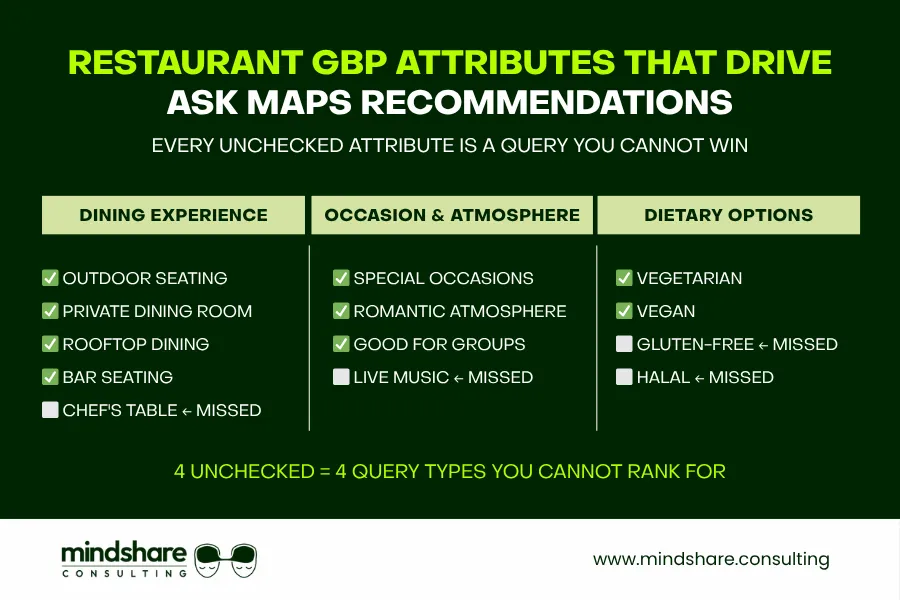
Dining attributes are the primary filter the Gemini AI applies before it even reads your reviews or photos. When a diner’s query includes a specific requirement outdoor seating, private dining, live music, good for kids, vegan options the AI eliminates every restaurant that has not explicitly checked that attribute in their GBP.
An unchecked attribute is an automatic exclusion from every query that includes that requirement. Your restaurant could be the best option in the city for a particular need but if the attribute is not checked, the AI will never know.
Work through the complete Google Business Profile attribute list for restaurants and check every option that genuinely applies to your business:
- Dining Experience Attributes: Dine-in, takeaway, delivery, outdoor seating, rooftop dining, bar seating, private dining room, chef’s table, open kitchen.
- Occasion Attributes: Good for groups, good for kids, good for special occasions, romantic atmosphere, sports viewing, live music or entertainment, reservations required or recommended.
- Dietary Attributes: Vegetarian options, vegan options, gluten-free options, halal, kosher, nut-free available on request.
- Practical Attributes: Wheelchair accessible entrance, accessible seating, gender-neutral restrooms, free parking, valet parking, accepts reservations, online booking available.
- Price Range: Set this accurately. Diners frequently include budget signals in their Ask Maps queries and the AI matches your price range attribute directly against those signals.
This is one of the fastest wins available for helping restaurants rank on Google Maps Ask AI Mode. It requires no content creation, no review strategy, and no technical work. It takes thirty minutes and immediately expands the range of queries your restaurant can be matched to.
Also check: How to use AI For Austin Restaurants Marketing to Get More Orders, Reviews, and Repeat Customers
Step 3: Build a Review Strategy Around Dishes and Occasions
This is where restaurants rank on Google Maps Ask AI Mode is won or lost more than anywhere else and where the gap between restaurants doing this right and restaurants doing it wrong is widest.
The Gemini AI does not count your reviews or average your stars. It reads the language your customers use. It scans every review for signals it can match to specific diner queries dish names, occasion types, atmosphere descriptions, service quality details, and dietary experience mentions.
A restaurant with 400 reviews of “Amazing food! Great service! Will be back!” is nearly invisible in Ask Maps. A restaurant with 120 reviews that mention specific dishes, occasions, and atmosphere details will consistently win recommendations over it.
The review language that makes restaurants rank on Google Maps Ask AI Mode:
- “We came for our anniversary dinner…” occasion signal
- “The truffle risotto was the best I’ve had in the city…” dish signal
- “The private dining room was perfect for our group of 12…” occasion and attribute signal
- “They were incredibly accommodating with my gluten-free requirement…” dietary signal
- “The rooftop view made the whole evening…” atmosphere and attribute signal
Each of those phrases is a direct match for a specific diner query. The more your reviews contain this language, the wider the range of queries your restaurant can be recommended for.
How to guide diners toward AI-readable reviews:
Train your front-of-house team to mention specific dishes and occasions in their verbal review requests: “If you enjoyed the tasting menu tonight, a Google review mentioning what you had would mean the world to us.”
Send post-visit WhatsApp or email follow-ups that guide the language: “Hi [Name], thank you for celebrating your birthday with us. If you have a moment, we’d love a Google review. It really helps if you can mention the occasion and your favourite dish from the evening.”
Respond to every review within 24 hours using the customer’s name, referencing their specific dish or occasion, and naturally reinforcing a location keyword: “Thank you, Sarah so glad the truffle pasta made your anniversary dinner special. We look forward to welcoming you back to our downtown Boston dining room.”
That response reinforces four signals simultaneously: the dish, the occasion, the atmosphere, and the location. Every response you write is read by the AI as an engagement signal that builds trust in your restaurant as a well-managed, responsive business.
If you want a review strategy built specifically around your restaurant’s menu and target occasions, explore Mindshare Consulting’s restaurant marketing services for exactly the kind of work that moves Ask Maps visibility.
Step 4: Build a Photo Library the AI Can Learn From
Photos are not just decoration in your GBP, they are content signals the Gemini AI uses to evaluate your restaurant’s atmosphere, food quality, and dining experience before recommending you.
Restaurants with rich, high-quality, well-captioned photo libraries consistently outperform restaurants with sparse or generic photo sets in Ask Maps recommendations even when other signals are similar.
Minimum photo targets for Ask Maps visibility:
25 to 30 total images across these specific categories: signature dish close-ups showing quality and presentation, interior ambiance shots showing lighting and atmosphere, outdoor or rooftop seating if available, private dining room if applicable, bar area, exterior, and team or kitchen shots that build personality and trust.
The technical details that most restaurants miss:
- Name every photo file descriptively before uploading to GBP. Add a caption to every photo describing what it shows. These file names and captions are read by the AI as content; they are not just meta data.
- Update your photo library regularly. Google’s systems favour active, regularly updated profiles over static ones. Adding two to three new photos per month signals that your restaurant is operational, current, and engaged.
Also check: The Future of SEO: Why Keyword Strategy is Dead and Authority Network Score will be King
Conclusion
Helping restaurants rank on Google Maps Ask AI Mode is not about doing more of what worked in 2022. It is about understanding that the AI makes its recommendation based on a completely different set of signals and then building your restaurant’s digital presence around those signals.
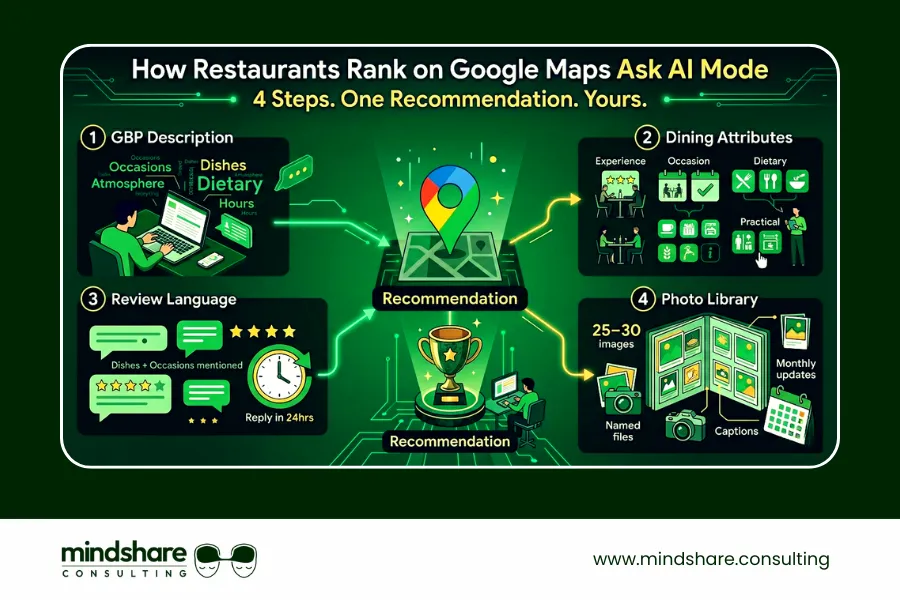
The four steps in this guide rewriting your GBP description for occasion-based queries, completing every dining attribute, building a review strategy around dish and occasion language, and developing a rich descriptive photo library are the specific changes that move the needle for restaurants in the Ask Maps era.
The restaurants doing these four things right are capturing the highest-intent diners in their city before competitors even appear on screen. The restaurants still relying on the old playbook are becoming invisible to exactly the customers most ready to spend.
The gap is closable but only with the right strategy applied consistently.
Connect with Mindshare Consulting to build a restaurant marketing strategy engineered specifically for Google Maps Ask AI Mode visibility in 2026 and start becoming the one restaurant your ideal diners are recommended every time they search.
FAQs
Further Reading: Restaurant Marketing
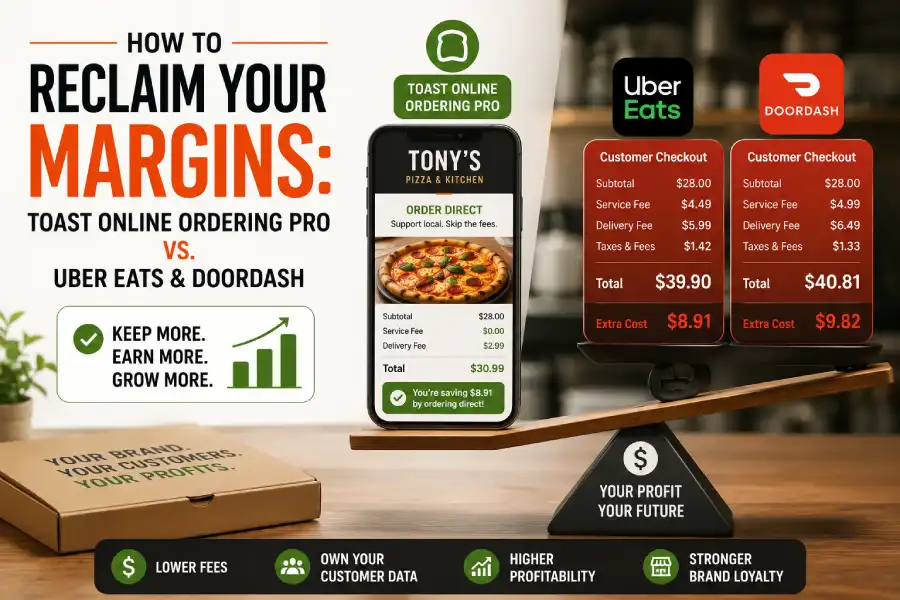
- How to Reclaim Your Margins: Toast Online Ordering Pro vs. Uber Eats & DoorDash
- Grasshopper Phone System for Restaurants: A Smarter Way to Manage Orders, Catering Calls, and Customer Questions
- Best POS System for Texas Restaurants: Which Platform Is Right for Your Restaurant?
- Restaurant Marketing Ideas: How to Market a Restaurant